Start an LLC in California in 6 Steps: $890 in State Fees, Then Get Found Online
You sell your first big job on a Friday. The check has your own name on it, not a firm name. That night you lie awake. If a job goes wrong, can a customer come for your house, your truck, your bank funds? You have heard friends say, "Get an LLC." But no one told you the steps, the fees, or the dates. This post gives you all 6 steps, with the real state fees and the real due dates — and then the half most new owners miss: the launch steps that make your formed firm show up when customers search. The state steps make you legal. The launch steps make you findable. Aid & Cos does not file LLCs. The launch steps are the part we build.
To start an LLC in California, you do 6 steps: pick a name, pick an agent, file Articles of Organization for $70, make an operating agreement, get a free EIN from the IRS, and file a Statement of Information for $20 in 90 days. You also owe an $800 tax each year to the state tax board. First year state fees add up to $70 + $20 + $800 = $890. Then claim your Google profile and put up a real web site, in the same first weeks, so the firm the state formed is a firm customers can find.
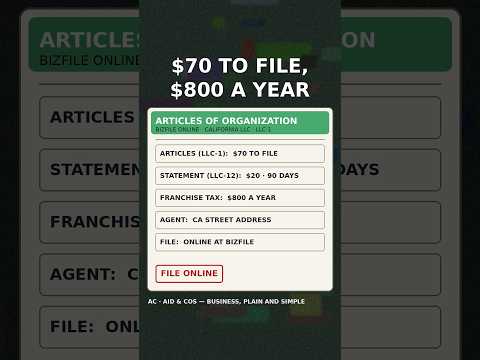
What the video shows: This short video is called "How to Start an LLC in California: File Online, Step by Step." It gives the online filing path for a California LLC in clear steps. This post walks through the full job in plain words: the name check, the agent for service of process, the Articles of Organization, the free EIN, and the papers and fees that follow.
What is an LLC?
LLC stands for Limited Liability Company. Liability means the duty to pay a debt or a loss. Limited means capped, or held to a limit. An LLC is a kind of firm the state lets you form. When the state forms your LLC, the law treats the firm as a thing apart from you. Apart is the key word. You own the firm. But the firm is not you. The firm can own funds, sign deals, and owe debts in its own name. If the firm owes a debt it can not pay, the folks it owes can take firm funds and firm things. In most cases, they can not take your house, your own truck, or your own bank funds for a firm debt. That wall is the main reason folks form an LLC.
Think of it like two houses side by side. Your house holds your own funds. The firm house holds firm funds. A firm debt knocks on the firm house door. It does not get a key to your house.
Here is the second way to see the same wall. Think of two bags. You carry one bag with your own funds. The firm carries a second bag with firm funds. If you keep the bags apart, a firm debt can reach in the firm bag only. But if you mix the funds in one bag, a judge may say the bags were one bag all along. Then the wall can fall. That is why this post will tell you, more than once: keep firm funds and your funds apart, from day one.
The wall is not magic. It does not cover debts you sign for in your own name. If you sign a loan and promise in your own name to pay it back, you owe it, LLC or not. It does not cover harm you do with your own hands. And the state can take the wall down if you treat the firm as a fake shell. Fake means not real. Real steps, real records, and apart funds keep the wall strong.
An LLC is not a tax trick. For tax, the IRS is the U.S. tax office. IRS stands for Internal Revenue Service. By default, a one owner LLC pays tax like a sole owner: the firm gains flow to your own tax form. Default means the way a thing is set if you pick no change. The LLC gives you the wall. It does not cut your tax bill on its own.

What does it cost to start, in full?
Here are the state costs, with the math in the open.
Cost 1: Articles of Organization filing fee: $70. You pay this once, when you file Step 3. Filing means to send a form to the state and have the state take it in.
Cost 2: Statement of Information filing fee: $20. You pay this in the first 90 days, then once each 2 years.
Cost 3: The yearly franchise tax: $800. A franchise tax here is a tax the state charges for the right to run as an LLC in California. You pay it each year to the Franchise Tax Board, the state tax office for California. Short name: FTB. You owe the $800 even if your firm made no money that year.
Add the first year: $70 + $20 = $90. $90 + $800 = $890. So the state cost for year one is $890 if you do all the steps your own self. You may also pay an agent firm or a pro, and your city or county may ask for a local business license. A license is a paper from the city or county that says you may run that kind of work there. Its fee changes by town, so ask your city clerk for the true fee.
And here is the full first year in one view — the state fees you owe, and the launch costs you choose:
| Item | What it is | Cost |
|---|---|---|
| Articles of Organization | The state filing that forms your LLC (Step 3) | $70, once |
| Statement of Information | The state form due in 90 days, then each 2 years (Step 6) | $20 |
| Franchise tax | The yearly tax to the FTB for the right to run as an LLC | $800, each year |
| Google Business Profile | Your listing on Google Search and Maps — free to claim your self | $0 |
| Get On The Map (Aid & Cos) | The same profile built and checked for you, done-for-you | $249.99, once |
| Web site (Aid & Cos) | Your own site: services, city, phone, hours | $499.99 to build + $19.99 a month hosting |
The first 3 rows are the state's. No one can waive them for you, and no service can file them "for free" — a service fee would come on top of the same $890. The last rows are your launch, and they are the rows that decide if the phone rings.

What is Step 1, pick a name?
Step 1 is to pick a name for your LLC.
Your name must have the words "Limited Liability Company" or a short form like "LLC" or "L.L.C." at the end. That tail tells all who read the name what kind of firm it is. Your name must not be the same as a name in use on the state list, and it must not be so close that folks mix the two firms up. You can search the state list of firm names for free on the California Secretary of State web site, in the part called bizfile Online. The Secretary of State is the state office that forms firms and keeps firm records.
Search with care. Type your first pick. If it is in use, type your next pick. Have 3 picks ready. That saves a stall if your first 2 picks are taken. A stall means a stop that wastes time.
Some words are held back by state rules. Words that make a firm sound like a bank, a trust firm, or an insurer need state OK first, and most new firms should just not use them. Insurer means a firm that sells plans that pay when bad things occur. If your pick has a word like that and your firm is not that kind of firm, pick a new name.
Do not order signs, cards, or a web site with the name until the state takes your filing in Step 3. Name first, filing next, print last. That order saves cash. And hold one more thought for the launch half below: the name the state takes is the name your Google profile and your web site must carry, word for word. Pick a name you can say on the phone and a customer can spell into a search box.
What is Step 2, pick an agent for service of process?
Step 2 is to pick an agent for service of process.
Service of process means the act of giving court or state papers to a firm by hand. An agent for service of process is a person or firm you name to take those papers for your LLC. Some folks call this role a registered agent. In California forms, the name used is agent for service of process. It is the same job.
The agent must have a street address in California where a person can hand them papers in work hours. A post office box does not count. A post office box is a mail box at the post office, not a place where a person stands to take papers by hand.
You can be your own agent if you live in California and you are fine with your home street address going on the public state list. Public means all can see it. Think hard on that point. Many owners do not want their home on that list. They name a trusted person at a shop address, with that person's clear OK, or they pay an agent firm to take papers and send them to you fast.
If you pay an agent firm, that fee is on top of the state fees. Agent firms set their own price by year, so this post does not name a price. What counts is this: the agent must be at that address in work hours, and must send you any papers the same day or the next day. A court paper can have a due date. Due date means the last day you may act. Pick an agent you trust to move fast.
You must name the agent in your Articles of Organization in Step 3, so pick the agent before you file. If your agent quits or moves, update the state with a new agent. Do not let it lapse. Lapse means to run out or stop being in force.

What is Step 3, file Articles of Organization?
Step 3 is the filing that forms your LLC. The form is called Articles of Organization. In California it is Form LLC-1.
You file it with the California Secretary of State. The fee is $70. You can file on the bizfile Online site, which is the fast path. When the state takes your filing, your LLC exists. Before that day, you have a plan. After that day, you have a firm in the eyes of the state.
The form asks for a few core facts. Core means the center and most key part. It asks for your LLC name, the firm's main street address in California, your agent's name and address from Step 2, and how the firm will be run: by its members or by a manager. Members are the owners of an LLC. Member is the word the form uses for owner.
Run by members means the owners run the firm day to day. Run by a manager means the owners pick one person to run the firm. Most one owner firms pick run by members. If you have 2 or more owners, talk this pick through before you file. It sets who can sign for the firm.
Keep the stamped copy the state sends back. Stamped means marked by the state to show it was filed. Your bank will ask for it in Step 5.
What is Step 4, make an operating agreement?
Step 4 is to make an operating agreement.
An operating agreement is a written deal among the owners that says how the firm will run. It can be short for a one owner firm. It must be longer if there are 2 or more owners. You do not file it with the state. You keep it with your firm records.
For a one owner firm, the agreement should still say key facts in writing: you are the sole owner, sole means the only one. You put funds or things into the firm to start it. You run the firm. If you die or can not run it, who takes over or winds it down. Wind down means to end the firm in an orderly way, pay its debts, and split what is left. One page with true facts, signed and dated, beats no page at all. It helps prove the firm is real and apart from you.
For 2 or more owners, the agreement does much more work. It should say: how much each owner put in. What share each owner holds, as a part of 100. For a worked case, say Ana puts in $6,000 and Ben puts in $4,000. Total put in is $6,000 + $4,000 = $10,000. Ana's share is 60%. Ben's share is 40%. Next, say how gains are split. A gain is money left after costs. Say who can sign deals, and up to what sum. Say how a big choice is made. Say what occurs if an owner wants out, dies, or stops work.
Write it while you still like each other. The best time to set fair rules for a hard day is on a good day, when no one is mad. If the sums are big or the owners are not kin, pay a lawyer for one review of your draft. Lawyer means a person trained in law who may give legal advice.

What is Step 5, get an EIN and open a bank account?
Step 5 has 2 parts that go as a pair: get an EIN, then open a firm bank account.
EIN stands for Employer Identification Number. It is a 9 digit number the IRS gives a firm for tax use. Think of it as the firm's own tax ID number. You need it to open a firm bank account, to hire staff, and to file firm tax forms. Staff means the people who work for the firm.
You get an EIN from the IRS. It costs $0. Free means no fee. Apply on the IRS web site, or by Form SS-4 if you must use mail or fax. Do it after Step 3, not before. The IRS will ask for your LLC's legal name and the date the state formed it. If a web site asks you to pay for an EIN, you are not on the IRS site. Close that tab and go to the real IRS site.
With your stamped Articles and your EIN in hand, open a bank account in the LLC name. Bring both papers. From that day, firm money goes in the firm account. Client checks go there. Firm bills get paid from there. Your pay from the firm moves to your own account as a clear transfer, with a note of what it is. Transfer means to move funds from one account to the next.
This is where the two bags idea from the start turns real. Firm bag: the firm account. Your bag: your own account. Never pay a home bill from the firm account. If you must put your own funds in to cover a firm bill, move the funds to the firm account first, note it as owner funds in, then pay the bill from the firm account. That paper trail is what keeps the wall strong if a debt ever goes to court.
What is Step 6, file the Statement of Information and pay the tax?
Step 6 is how you keep the firm in good standing. Good standing means the state sees your firm as live, true, and up to date.
Part A is the Statement of Information. It is Form LLC-12. You file it with the Secretary of State. The fee is $20. Your first one is due in 90 days from the day your Articles were filed. Count it out: if your Articles were filed on March 1, 30 days takes you to March 31, 60 days to April 30, and 90 days to May 30. Plan to file by May 30 in that case. Do not wait for day 90.
After the first one, you file a new Statement of Information each 2 years. The form asks for your firm's address, your agent's name and address, the names of your managers or members, and the kind of work you do. A late form can bring a fine. Fine means extra money you must pay as a penalty. File on time and the fee stays $20.
Part B is the $800 yearly franchise tax. You pay it to the Franchise Tax Board, not to the Secretary of State. Two state offices, two duties. Do not mix them up. For a new firm, the first $800 is due by the 15th day of the 4th month after your tax year starts. When your Articles come back, ask the FTB site or a tax pro for your exact first due date, and write that date next to the 90 day date on your wall list. Then pay by that date, each year, as long as the firm is alive in California.

The state made you legal. It did not make you findable.
Now the half the state can not do for you. The Secretary of State put your firm in the state's books. No customer searches the state's books. Customers search Google, on a phone, in a hurry, and they pick from what shows up. A firm with no Google profile and no web site does not show up. These launch steps give your formed firm a face.
Launch step 1: one true name, everywhere. The legal name on your Articles and your EIN letter is now your firm's one true name. Use that same name — same words, same spelling — on your Google profile, your web site, your bank account, and your cards. A Google profile whose name does not match the real firm name can be flagged, held back, or trusted less by the folks who read it. A customer who sees one name on Google and a second name on your site feels a doubt she can not name, and doubt kills calls. One firm, one name.
Launch step 2: claim your Google Business Profile. This is the free listing that puts your firm on Google Search and Maps — your name, your phone, your hours, your city, your reviews. Claiming it means you tell Google the firm is yours, pass Google's check that you run it, and fill in each field with care. It costs $0 to do your self. If you want it done for you, that is our Get On The Map service at $249.99 — we build and check the profile with you, and you own it.
Launch step 3: put up a real web site. A social page is not a web site. You do not own it, you can not fix its shape, and it hides your phone behind taps. Your own site is the one place on the web that is yours: your services in plain words, your city, your phone in clear view, your hours, and a way to reach you that works at 2 a.m. Our web sites cost $499.99 to build, with hosting at $19.99 a month. Hosting means the site lives on a server, kept up and reachable, so your page is there each time a customer looks.
Launch step 4: guard what you built. A new firm's site and profile draw spam, fake edit tries, and worse. Site security means the checks, locks, and watch that keep your page yours and your forms clean. Our security service is $79.99 a month — $69.99 a month on a site we built, and $49.99 a month in the bundle with hosting.
What does Aid & Cos do — and not do?
Be clear on the line, because ads blur it on purpose. Aid & Cos does not file LLCs. We do not file your Articles, we do not act as your agent for service of process, and we do not give legal or tax advice. The 6 steps above are yours to file, or a lawyer's or tax pro's to guide for your own case.
What we build is what customers find after you file: your Google profile, your web site, your security, your review habit — the online face of the firm. That is the Online Digital Presence half of your launch, and it is the half that turns a formed firm into a called firm.

What are the most common mistakes?
Mistake 1: You get the EIN first, or pay a site for it. The EIN is free from the IRS and comes after the state filing.
Mistake 2: You mix funds. You pay for firm gas with your own card, pay rent from the firm account, and keep no notes. Mixed funds weaken the wall that was your whole reason to form the firm.
Mistake 3: You miss the 90 day Statement of Information. New owners miss this one most. The Articles feel like the end. They are not. Put the date on your wall the day your Articles come back.
Mistake 4: You think the $800 is due only if you earn. It is not. It is due for the firm being alive in California. Budget for it from month one. $800 split by 12 months is $800 / 12 = $66.67 a month. Set that sum aside each month and the due date will not sting.
Mistake 5: You name your home as agent with no thought. Your home address then sits on a public list. If that fact would worry you, pay for an agent firm or name a trusted person at a shop address.
Mistake 6: You skip the operating agreement since the state does not take it. The state does not file it, but the law says you must have one, and your bank may ask for it. Write it in Step 4, while things are calm.
Mistake 7: You file and stop. The paper sits in a drawer, the profile is never claimed, the site is "for later." Later is when the firm down the street — formed the same week, claimed and posted — takes the calls that should have been yours.
Your free tool for this step
Your filing made the firm real on paper. Now grade the face customers see. Use the GMB Profile Grader on Aid & Cos at https://aidcos.world/#free-tools
The GMB Profile Grader is a guided check. Guided means it walks you step by step. It gives your Google profile a letter grade from A to F, like a school grade. A is the best. F is the worst. It names the 3 fixes that matter most, so you work in the right order: first fix first, not last fix first.
Use it the week you claim your profile. Grade the profile, do the 3 fixes it names, then check again after the fixes show. The tool is free. Go to https://aidcos.world/#free-tools and look for the GMB Profile Grader.

The bottom line
Start your California LLC in 6 steps, in order. Pick a name the state will take, with LLC at the end. Pick an agent with a California street address. File Articles of Organization, Form LLC-1, for $70. Make a written operating agreement. Get a free EIN from the IRS and open a bank account in the firm name. File your Statement of Information, Form LLC-12, for $20 in 90 days and each 2 years after. Pay the $800 franchise tax each year the firm is alive.
Add it up once more: $70 + $20 + $800 = $890 in state costs for year one if you file your own self. That sum buys you a real firm with a wall between firm debts and your own things, as long as you keep real records and apart funds. Then do the half that brings the calls: one true name everywhere, a claimed Google profile, a real web site, and basic security on both. The state steps make you legal. The launch steps make you found. Do both, in the same first weeks.
Part of: Google Business Profile Help: Costs, Fixes, and Guides for Local Businesses
More guides in this branch:
Keep reading: all Aid & Cos deep-dives