1 Star, No Words: Your Reply Still Works

You open your phone in the morning. A new review is in. One star. No words at all. Your chest feels tight. You want to know what went wrong. There is no clue to read. You want to delete it, or fire back. Do not do either one. A short, calm reply under that lone star is one of the best trust signs on your profile. This post shows you the shape of that reply, word for word.
Reply soon, in a day or two, with 4 moves: thank them, say you are sorry the visit fell short, name one true thing you stand on, and invite them to call you direct. The reply is for the next buyers who read it, not just for the one who left the star.
What the video shows: This short video is called "Bad Google Review? Reply Like THIS (Don't Argue)." It is about how to reply to a bad Google review: answer in a calm, kind way, and do not argue in public. That is the same job this post teaches for the hardest case of all — a 1-star review with no words to go on.

Who will read your reply, in truth?
This is the hardest idea in this post, so we will say it two ways, with two pictures in your mind.
First picture: think of your reply as a sign in your front window. The one buyer who left the star may walk past that sign once, or may never walk past it again. But each new buyer on the street reads the sign as she walks by. She reads it to judge you. Is this shop calm? Does this shop care? Would this shop treat me well if my visit went wrong? Your sign answers her, not just him.
Second picture, same rule: think of your reply as a note you pin to a board in a town hall. You wrote the note about one visit. But the whole town can read the board. A kind, clear note makes the whole town trust you more. A harsh note makes the whole town trust you less, even folks who never met the first buyer.
So write for the crowd, not for the one. The crowd is large. Say your profile gets looked at by 20 buyers in a week. That is 20 reads of the review and your reply. In 4 weeks, that is 20 times 4, which is 80 reads. 80 buyers will judge your shop by a reply that took you 3 minutes to write. Three minutes of calm work that speaks to 80 buyers is a fair trade. An angry reply speaks to those same 80 buyers too, but it tells them to stay away.
The reviewer may come back or may call. That is a good extra. Do not count on it. Your real win is the trust of buyers who have not called yet.
What are the 4 moves of a good reply?
A good reply to a wordless 1-star has 4 moves, in this order. Learn the order once and you can use it each time.
Move 1. Thank them for the visit and for the feedback. Feedback here may be just the star itself. Still thank them. Thanks costs you nothing and it sets a calm tone at the start. Tone means the feel of your words.
Move 2. Say you are sorry their visit fell short. Fell short means it did not meet what they hoped for. Say sorry for their bad time. Do not admit facts you do not know. You do not know what went wrong, since they wrote no words. So do not say “sorry we were late” or “sorry the food was cold.” You do not know if either is true. A broad, true sorry is safe and kind: you are sorry the visit was not what they hoped.
Move 3. Name one true thing you stand on. Pick one fact about how you work that is true each day. For case, “we check every job before we leave.” Or “we wash each tool before each use.” Keep it general. General means it covers your work as a whole, not one visit in fine detail. Keep it true. If you do not check every job, do not claim that line. Pick a line you can back on your worst day, not just your best day.
Move 4. Invite them to reach you direct by phone. Give the phone number you use for buyers. Say you want to learn what took place and make it right. Make it right means to fix the harm as best you can. The invite moves the talk off the public page and into a real call, where you can hear facts and help in a real way.
Four moves. Thank. Sorry. One true stand. Invite to call. Short is fine. A reply of 4 to 6 short lines can do all 4 moves well. Long is not better. Long can sound like you protest too much. Write it, read it out loud once, fix any line that sounds hot or stiff, then post it.
What does a full good reply look like, word for word?
Here are 2 full replies. Both use the 4 moves. Both fit a wordless 1-star. Change the stand line and the phone part to match your own shop and your own true facts. Do not copy a stand line that is not true for you.
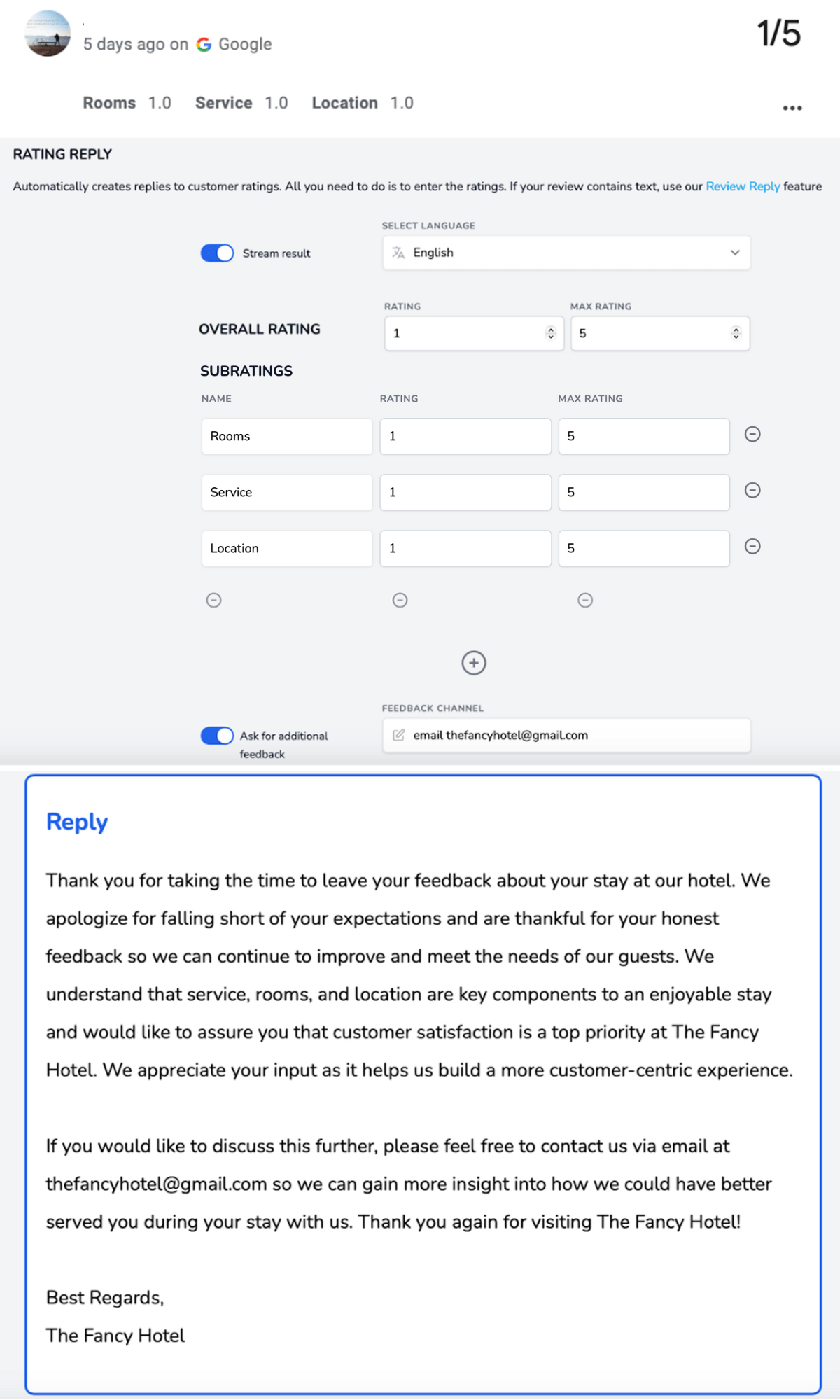
Reply 1, for a service shop. “Thank you for coming in and for sharing your feedback. We are sorry your visit fell short of what you hoped for. We check every job before we leave, and we want each visit to meet that bar. Please call us direct so we can learn what took place on your visit and make it right. We would value the chance to hear you out.”
Read the moves back. Thank is line 1. Sorry is line 2. Stand is line 3: “we check every job before we leave.” Invite is lines 4 and 5. No guess. No blame. No plea to change the star.
Reply 2, for a shop where buyers sit and stay a while. “Thank you for your visit and for the star rating. We are sorry we did not give you the visit you came in for. We greet each guest at the door and check in while you are with us, and we are sad we missed the mark this time. Please call us direct and ask for the owner. We want to hear what felt off so we can fix it and make it right for you.”
Read this one back too. Thank is line 1. Sorry is line 2. Stand is the greet-and-check line in line 3. It is general and it is the kind of line you must swap for your own true habit. Invite is lines 4 and 5, with a clear name for who to ask for.
Note what both replies lack. No “we think this is fake.” No “you have the wrong shop.” No gift or deal if the star goes up. No long tale of your hard day. Each reply could be read by a judge, a child, or your best buyer, and still sound calm and fair. That is the test.
How do you write your own stand line with care?
Move 3 is the move owners get wrong most. They pick a line that sounds grand but is not quite true. Or they pick a line that is true of one good worker but not of the whole shop.
Use this 3-step check for your stand line.
Step 1. Write 3 lines you think are true. Keep each line short. One habit per line.
Step 2. For each line, ask: did we do this on each job last week, even the hard jobs? If the answer is “most jobs” or “when we recall,” the line fails. Cross it off.
Step 3. Keep the one line that passed. If none passed, write a more plain line. A plain true line like “we clean the work area before we leave each job” beats a grand line you cannot back. Plain and true wins trust. Grand and shaky loses it, and a buyer may call it out in a new review.
Save the line in your notes. You can use a close form of it in most replies. Change a word or two each time so replies do not read as one pasted block.
What must you never do in a reply?
Trap 1. Argue. Do not fight the star in public. Do not write in all caps. Do not use sharp words. A fight in a reply tells the crowd you are hard to deal with when things go wrong. That one lesson will cost you more calls than the star cost you.
Trap 2. Guess who it was in public. Do not write “we think you were the man who came in late on Friday.” You may guess wrong. Even if you guess right, you share facts about a buyer in a public place. Never share a buyer's private facts in a reply. If you think you know the visit, save that talk for the phone call.
Trap 3. Accuse them of faking it. Do not write “this is fake” or “you never came here” in the reply, even if you doubt the review. In public, doubt reads as blame. If you have real proof a review breaks the rules, use the flag path in its own part of this post. Keep the reply calm in all cases.
Trap 4. Offer a bribe for a change. Bribe here means pay or a gift given to sway the review. Do not offer cash back, a free job, or a deal if they take the review down or raise the star. That breaks Google policy. Policy means the rules Google sets for its site. You may not pay or reward for reviews. You can invite them to call so you can make the visit right. That is care for the buyer. You cannot tie that care to a new star. The line is clear. Stay on the care side of it.
Trap 5. Paste the same long reply on every review. Buyers can see all your replies on one page. If each reply is the same long block, word for word, it reads as a robot, not a person. Robot replies kill the trust the reply was meant to build. Use the same 4 moves each time. Use fresh words each time. Thank in a new way. Phrase the stand in a new way. Short, fresh, and human beats long and pasted.
Trap 6. Wait weeks and then reply in anger. Old anger reads worse than fresh calm. See the speed part next.
How fast should you reply, and why?
Reply soon. Within a day or two is the goal. A day means 24 hours. Two days means 48 hours. If the star came in on Monday, aim to reply by Tuesday or Wednesday.
Why does speed count? The visit is still fresh in the reviewer's mind. A call in that span has a real chance to clear up what went wrong. A call 3 weeks later starts cold. The facts are dim for both sides. Help is much harder then.
Speed counts for the crowd too. A profile with a fresh star and no reply looks left alone. A profile with a fresh star and a calm reply looks cared for. New buyers who look that week see the cared-for form. That is the form that earns calls.
Set a rhythm so speed does not rest on mood. Rhythm means a time pattern you repeat. Check reviews once a day, at the same calm time. Morning before doors open works for many shops. Read new reviews. Reply to the new ones in that same block. A block of 10 minutes a day is 10 times 7, which is 70 minutes a week. That small cost guards the page that brings you buyers all week long.
What if you see the review late? Reply late rather than never. A brief “thank you for your feedback” still opens well. Then do the 4 moves as usual.

Can you get a wordless 1-star taken down?
At times, yes. At most times for this kind of review, no. Know both sides so you spend your time well.
You can flag a review for removal in your profile manager. Flag means you ask Google to check the review against its rules. Profile manager means the tools Google gives you to run your profile. Grounds that can work are clear breaks: spam, a fake review with no real visit, a conflict of interest, or talk that is off-topic for your shop. Conflict of interest means the reviewer gains from harm to your shop, like a rival shop owner who posts as a buyer. Spam means junk posts sent to harm or to sell, not a real buyer's view. Off-topic means the words are about a wholly new subject, not your shop at all.
A bare 1-star with no words, from a real visit, is a poor fit for those grounds. It breaks no clear rule on its face. Google will in most cases let it stay. That is not a flaw in you. It is how the rules treat a real buyer's low score. Plan as if it will stay. That plan points you back to your real tool: the reply.
If you do flag, flag once, with facts. State the ground in plain words. Then go and write the good reply anyway, while you wait. Do not hold the reply hostage to the flag. If the review is taken down, fine. If it stays, your reply is already there doing its work for the crowd. If you paste anger in the reply and the review stays, the anger stays with it. Calm is the safe bet in both ends.
Do not pay a firm that vows to wipe all bad reviews for a fee. No firm can vow that with truth.
Your free tool for this step: the Review Response Writer
Draft your reply with the Review Response Writer on the Aid & Cos site. You paste a Google review plus its star rating. The tool gives you a professional response draft. Professional means calm, clear, and fit for public view. It also gives you the principles behind the draft, so you learn why each line is there. Principles means the base rules the draft rests on. For a wordless review, be honest about the input: you paste the star rating and what you know of the visit. If you know nothing of the visit, say so in what you give the tool. Do not invent facts for it to use. Read the draft with the 4-move check. Thank, sorry, one true stand, invite to call. If the draft admits a fact you do not know, cut that line. If the stand line is not true for your shop, swap in your checked line. Then post in your own fresh words.
The bottom line
A wordless 1-star feels hard since it gives you nothing to work with. Work with what you have: a calm, short reply built on 4 moves. Thank them. Say you are sorry the visit fell short, with no guess at facts. Name one true thing you stand on. Invite them to call you direct so you can learn and make it right. Reply in a day or two. Never argue, never guess who it was in public, never offer a reward for a new star, and never paste the same block each time. Flag a review only when it breaks a clear rule. In all other cases, the reply is your tool, and it speaks to each buyer who reads your page next.
Part of: Google Business Profile Help: Costs, Fixes, and Guides for Local Businesses
More guides in this branch:
Keep reading: all Aid & Cos deep-dives