8 Words That Earn the Review (Steal This Script)
Your happiest customers are silent. Not because they would not leave a review — because nobody asked them at the moment it was easy to say yes, in words short enough to actually come out of a busy human's mouth. The ask that works is eight words long, it takes four seconds, and it follows two rules Google enforces strictly. Here is the script, the timing, and the boundaries.
A review, in this post, is a public note a customer leaves on your Google listing: stars plus words that the next buyer reads before they call. Reviews matter because that next buyer trusts past buyers more than your own ads. This post teaches one full system: ask each customer, in eight words, at the peak moment; make the yes easy to act on; answer each review you get; and keep the whole thing inside Google's rules.
The script is: "Would you leave us a Google review today?" — eight words, one question, no pressure. It works because of when it lands: at the peak moment, right after the customer has just said something good out loud ("that looks great," "you saved us"), asked of every customer equally. Two boundaries keep it legal and durable: never offer anything in exchange for a review — Google prohibits incentivized reviews — and never screen who gets asked based on how happy they seem, because Google prohibits review gating. Ask everyone, offer nothing, ask at the peak. That is the entire system.
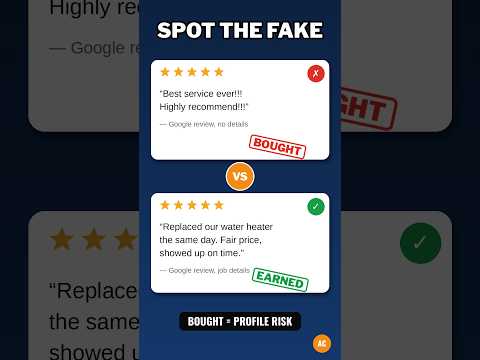
What the video shows: This short video is called "Get More Google Reviews: Ask Happy, Never Buy Them." Its rule is plain: ask the customers who are happy with your work, and never buy reviews. This post gives you the words for that ask and the habits that help happy customers follow through.

Why eight words beat a speech
Count the script with your fingers: Would (1) you (2) leave (3) us (4) a (5) Google (6) review (7) today (8). Each word does a job. "Would you" makes it a real question the person can say yes or no to. "Leave us" names who gets it. "A Google review" names the exact thing — not "some feedback," not "a rating online someplace." "Today" names when, in a soft way that creates a plan instead of a vague someday.
Every extra clause is an exit door. A clause is an added part of a sentence that carries its own idea. "If you have a moment and you were happy with everything, we'd really appreciate it if maybe—" is a paragraph a customer agrees with and forgets. It has four soft spots where a busy mind can slip out: if you have a moment, if you were happy, we would appreciate it, maybe. The customer nods. The nod feels like a yes. Nothing is posted, because no clear ask was ever made and no clear time was named.
Eight words is a question with a yes already inside it. It takes about four seconds to say. Four seconds fits in real life: at the till, at the door, at the sink you just fixed. A speech does not fit, so staff skip it when the day gets busy. A short script gets said. A long script gets dropped by week two. That is the first reason short wins: it survives busy days.
Then make yes effortless. Give the customer a short link or a QR code at the counter, on the invoice, and in the follow-up text, so the distance between "sure" and a posted review is one thumb-tap. A QR code is the square pattern a phone camera can read to open a link at once. Test that link yourself, on your own phone, before you print it anywhere. A code that opens the wrong page, or a page that asks for a long login with no path forward, kills the yes you just earned. Walk the whole path once as a customer would: tap, see your business name, see the stars, write a line. If any step confuses you, it will stop them too.
The peak-moment rule
Timing is the multiplier. The ask lands when satisfaction is at its highest and already verbalized — the car starts, the faucet runs clear, the haircut gets its first mirror smile. Verbalized means said out loud in words. Train the team on the trigger, not a quota: hear the compliment, say thank-you, ask the eight words. A trigger is the event that tells you "now is the moment." A quota is a set number each worker must hit. Quotas push staff to ask at bad moments just to reach the count. Triggers teach staff to listen.
Here is the moment, step by step, in a repair shop. The tech turns the key. The car starts clean. The customer smiles and says, "Oh good, it runs great." That sentence is the trigger. The tech says, "Thank you — glad we got it sorted." Then, right there, with no gap for the moment to cool: "Would you leave us a Google review today?" The customer is still feeling the relief they just named in words. The ask joins that feeling while it is live.
Miss that beat and the same customer must rebuild the feeling later from memory. Memory is weaker than the live moment. That is why the same words tomorrow by text still work, but work at half strength — a claim from the first draft of this lesson, kept as a plain guide, not a fixed law. Human recall fades fast. By next week, the fix is just part of normal life again. The peak is short. Use it.
What if the customer does not praise the work out loud? Then the end of a smooth job is still your best moment: work done, bill clear, no open problem. Thank them for coming in. Ask the eight words in the same calm tone. Do not hunt for praise that is not there, and do not act hurt if the answer is a plain "okay, maybe." A light ask, kindly left alone after one try, protects the goodwill that brings that customer back. Goodwill here means the warm feeling a customer holds toward your shop. One push too hard can spend it all.
How do you teach the whole team to do this the same way?
Say the script out loud together once, so every person hears how plain it sounds. Role-play two short scenes: one happy customer at the counter, one busy customer in a rush. Role-play means act it out for practice, with one person playing the customer. In the rush scene, the right move is to ask once, smile, hand over the card with the code, and let them go. No second ask. No guilt.
Put the script where the job ends: near the till, on the invoice pad, on the door of the work van. A cue in the place of use beats a note in a training file no one opens. For a week, ask each team member at day's end: did a trigger moment come up, and did you ask? Praise the tries, not just the posted reviews. You are building a habit. Habits grow from tries that get noticed.

The follow-up message: the second chance done right
Even a perfect peak ask loses some yeses to real life. A child cries. A bus comes. A phone dies. The customer meant it and forgot. The aftercare follow-up exists for them. Aftercare means the care and contact after the job is done.
Send one short message later the same day, or the next day, while the result is still fresh and easy to recall. Keep it to three short parts. First, thank them by name for the job, naming the work in a few words: "Thanks for trusting us with your sink repair, Ana." Second, check that all is well: "Hope the drain is still running clear." Third, give the link and the same plain ask: "Would you leave us a Google review today? Here is the link."
One message. Not three. A chain of nudges turns a kind nudge into noise, and noise trains people to ignore or block you. If they do not answer, let it rest. The next time they use your service, the peak ask gets a fresh chance.
Do not add an offer to the message. No discount on the next job for a review. No gift. No entry into a draw. That line is not a style choice. It is the rule in the next section, and it holds for texts, emails, cards, and signs in the shop just the same.
The two boundaries, stated plainly
Google's rules, not etiquette: reviews must never be bought — no discounts, gifts, or entries in exchange — and you may not gate, meaning you cannot pre-screen customers and only invite the happy ones. Incentivized means a review was paid for or rewarded in any form, even a small one. Gating means you test how a customer feels first, then ask only the happy ones for a public review while steering the unhappy ones to a private form. Both tricks shape the public record so it lies by design: stars go up, but trust should go down, because the set of reviews no longer shows what buyers truly felt across all jobs.
The FTC polices the same territory from the consumer side. FTC is short for Federal Trade Commission, the U.S. agency that guards buyers from unfair business acts. Fake or bought praise misleads the next buyer. That is the harm both sets of rules aim at.
The beauty of the eight-word system is that it needs neither trick: asked of everyone at the peak, incentives add nothing the moment is not already providing. Ask everyone means everyone whose job is done — the thrilled, the calm, the quiet, the merely content. You do not grade their mood first. You do not skip the shy ones. Equal asks keep you lawful and, over time, give a truer picture that smart buyers can smell as real.
What should you do with an unhappy customer, then? Serve them. Listen. Fix what can be fixed. That care is not a review tactic; it is the work. If they later choose to review, that is their right, and your calm public reply — covered next — is your right. A shop that only hears praise in public and rage in private learns nothing. A shop that hears both, and answers both well, earns a record buyers believe.
Answer every review like it is a storefront window
The second half of the system is invisible to most owners: replying. A thoughtful reply to a five-star review thanks a person in public; a calm, specific reply to a two-star review shows the next hundred readers how you behave when something goes wrong. Prospects read your replies more carefully than your stars. A prospect is a likely future buyer who has not bought yet. Treat each reply as the cheapest advertising you will ever write.
For a kind review, reply within a day or two if you can. Name one true detail from their words: "Thanks, Ana — glad the drain is still clear and the kitchen is back in use." A reply that could be pasted under any review reads as a machine's work. A reply that names the job and the result reads as a person's thanks. Keep it to two or three short sentences. Do not pitch a new service in a thank-you. That turns thanks into an ad and sours the gift.
For a mixed or low review, slow down before you type. Read it twice. Breathe. Your reply is not mainly for the angry writer — it is for the hundred quiet readers who will judge your temper and your care. Use four calm moves. Thank them for the note. Name the problem as they stated it, without mocking or shrinking it. Say what you did or will do to make it right, in plain facts. Invite them to reach you by phone or in person so the fix can be real, not a public fight. Do not argue facts line by line in public. Do not blame the customer. Do not hint that they lie. If a claim in the review is false in a way that breaks Google's rules, you can flag the review for Google to check — flagging means asking the platform to review it — but write your calm reply anyway, as if it will stay. Most reviews stay.
Never copy the same reply under every review. Buyers spot a pasted script in seconds, and it undoes the trust the habit was meant to build. Short, true, and fresh beats long and polished.
How do you know the system is working?
Watch three plain signs over a month. First, count the new reviews each week. You are not chasing a magic number — you want a steady flow that matches how many jobs you finish. Second, read the words in the reviews. If buyers start naming your staff, your care, and your clear bills, your replies and your work are teaching the market what you are. Third, note how many asks your team truly made. If the asks are low, the flow will be low, and the fix is habit and cues, not a new trick.
Honest limits: you cannot control who writes, what stars they give, or when Google shows a review. Some reviews are held or filtered by Google for its own reasons, and good asks will still be ignored by most happy customers — most people, asked kindly, still do not post. That is normal. This system raises your true rate by sound means. It does not, and must not, promise a set star score or a set count by a set date. If a service offers you that promise for a fee, it is offering the bought-review road that puts your listing at risk.
Your free tool for this step: the Review Response Writer
Replies stall because owners stare at the blank box. The free Review Response Writer on aidcos.world drafts a reply in your tone — grateful for the praise, steady for the criticism — that you review and post in your own voice. Pair it with the eight-word ask and the whole review engine runs in minutes a week. One free signup opens all the Aid & Cos tools.
The bottom line
Ask everyone, offer nothing, ask at the peak — and say it in eight words: "Would you leave us a Google review today?" Then answer every review like the neighborhood is reading. It is.
Part of: Google Business Profile Help: Costs, Fixes, and Guides for Local Businesses
More guides in this branch:
Keep reading: all Aid & Cos deep-dives