7 Steps to Start Your Texas LLC for $300
You do good work in Texas. You fix, you build, you clean, you cut, you haul. Clients pay you. But the pay goes into your own bank account, right next to the money for rent, gas, and food for your kids. One bad job. One hurt client. One bill you cannot pay. And you lie awake and ask: can they come for my truck? Can they come for my home? A friend tells you, "You need an LLC." Then you search online and the prices make no sense. One site says $300. One site says $800 and will not tell you why. This post gives you the real Texas math and the real Texas steps, in plain words. You will see what the state charges, what is free, what you pay only if you want help, and what you must do each year in Texas — which is not the same as Florida or most other states.
A Texas LLC takes 7 steps: pick a name, pick a registered agent, file the Certificate of Formation with the Texas Secretary of State for $300, make an operating agreement, get a free EIN from the IRS, open a bank account in the LLC name, and each year file a Public Information Report with the Texas Comptroller by May 15. Texas has no yearly report to the Secretary of State. The one state fee to form is $300, paid once. Do the steps in order and keep business money apart from your own money.
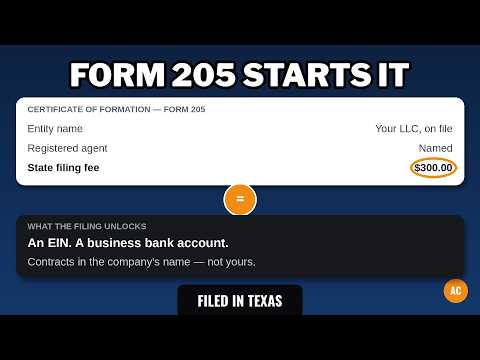
What the video shows: This video is called "1 Filing, $300, the State Only You Can Start With, how to start an llc in texas." It is about how to start an LLC in Texas, and it centers on the one state filing that starts the LLC and the $300 state fee that goes with it. The steps in this post walk through the rest in plain words: the name search, the registered agent, the free EIN, and the Texas reports you file each year.

What is an LLC, and why does it matter to you?
LLC is short for Limited Liability Company. That is a long name, so let us break it into small parts.
Limited means capped. It means there is a line and the debt stops at the line. Liability means a debt you owe, or pay you must make for harm. Company means your business group, set up with the state.
So an LLC is a business form the state makes for you. It draws a line between two piles of money. Pile one is business money. Pile two is your own money, your home, and the cash you saved for your kids.
If your business owes money and you did the steps right, the people you owe can go after pile one. They cannot cross the line to pile two just because you own the business.
An LLC does not stop all risk. If you sign your own name on a loan and say, "I will pay if the business cannot pay," that promise still counts. The bank can hold you to your word. If you hurt a person with your own hands, you can still be held to blame for what you did. An LLC is not a magic shield. It is a clear line, and the line holds only if you respect it each day.
An LLC also does not do your taxes for you. Taxes are a step after you form, and Texas has its own tax step, which we teach in Step 7. For now, hold this one thought: form it right, then run it right, day by day.
Step 1: How do you pick a name Texas will accept?
Your name is step one for a good reason. If the name is wrong, the state says no, and you lose days and must file again.
Texas has two main rules for an LLC name.
Rule one: the name must show it is an LLC. It must have the words "Limited Liability Company" or a short form like "LLC" in it. Most small shops put "LLC" at the end. A name like "Lone Star Roof Care, LLC" follows this rule. A name like "Lone Star Roof Care" with no LLC at the end does not.
Rule two: the name must be easy to tell apart from names that are on file now. The state word for this is "distinguishable." That means not the same, and not so close that people mix the two shops up.
Say a shop on file is called "Lone Star Roof Care, LLC." You cannot pick that same name. You should not pick a name that is just one small word off, if clients would mix you up. Pick a name that is yours in a clear way.
Search your name before you file. You have two free ways to check. The Texas Comptroller has a free Taxable Entity Search. Taxable Entity means a business the state taxes. That search shows names of Texas businesses on file. You can also ask the Secretary of State if a name is free. Start with the free search. It takes a few minutes and can save you a failed filing.
Search like this. Type your full name idea, with LLC at the end. Look at what comes up. Then search just the main words, with no LLC. Look again. If you see the same name, pick a new name. If you see a very close name in the same kind of work, pick a new name to be safe.
Do not buy signs, cards, or shirts until the state says yes to your filing. A search is a good check. It is not the final yes. The filing is the final yes. Wait for it, then spend on print.
Test your name out loud, too. Say it like you would on the phone. Can a client spell it after they hear it once? If not, pick a more plain name. A clear name beats a cute name when a client tries to find you later on Google or by text.
Step 2: What is a registered agent, and who can be yours?
A registered agent is a person or a company that takes legal papers for your business. Legal papers are court papers or state papers that must be handed to your business in the right way.
Think of the agent as the front desk for court mail. If a person sues your business, they do not hunt for you on a job site. They hand the papers to the agent. The agent gets the papers to you fast, so you do not miss a court date.
Texas has clear rules for an agent.
The agent must have a real Texas street address. A street address is a place on a map where a person can walk in, like a home or an office. A P.O. box does not count. A P.O. box is a small mail box at the post office. No person sits there to take papers by hand, so it fails the rule.
The agent must be at that address in normal work hours to take papers. Normal work hours means the hours when most offices are open.
The agent must say yes to the job. In Texas, the agent must give consent. Consent means the agent agrees, in writing, to do this job. A name you type on a form is not enough if that person never said yes. Keep the consent paper in your LLC folder.
Can the agent be you? Yes, if you are at a Texas street address in work hours and you say yes to the job in writing. Many solo owners start as their own agent. That choice costs $0.
But think about one trap. The agent address goes on the state record, and state records can be seen by the public. If you use your home address, your home address is now out for all to see. If you do not want that, do not use your home as the agent address.
Some owners pay a company to be the agent. Paying can keep your home address off the record and give you a steady front desk. Doing it yourself costs $0, but you must be there when papers come. Both ways are legal. Pick the one that fits your life.
Your LLC cannot be its own agent. The agent must be a person or a firm apart from the LLC itself. That rule makes sense when you think of the job: the agent must be there to take papers for the LLC, as a set pair of hands the state can find.
If your agent moves or quits, tell the state and name a new agent. Do not let this part go stale. A missed court paper can cost you the whole case, even if your work was good.
Step 3: How do you file the Certificate of Formation for $300?
Certificate of Formation is the name of the paper that births your Texas LLC. Certificate here means an official paper from the state. Formation means the act of forming, or making, the group. Texas uses this name. Some states use a name like Articles of Organization for the same kind of paper. In Texas, ask for the Certificate of Formation. It is Form 205.
Secretary of State is the state office that keeps business records in Texas. You file Form 205 with that office. You can file online on the state portal. Texas moved from the old SOSDirect system to a new portal called SOSPortal in September 2026, so if an old guide says SOSDirect, the name of the site has changed, but the form and the fee are the same job. You can also file by mail. Both ways end at the same office and cost the same state fee.
Here is the math, shown plain, so no site can fool you.
State filing fee: $300 EIN at IRS.gov: $0 Name search on the Comptroller site: $0 Total state cost to form if you do it yourself: $300 + $0 + $0 = $300
That $300 is paid once. It is not a fee you pay each year. Texas does not charge a yearly fee to the Secretary of State to keep your LLC alive. The yearly Texas job is a report to a different office, the Comptroller, and we teach it in Step 7.
One small add-on to know. If you pay by card, the state adds a card fee. The sources for this post put that fee at 2.7% in most guides. The math on $300 is $300 × 2.7% = $8.10, so $300 + $8.10 = $308.10 by card. One newer guide put the card cost a bit lower, at $0.25 plus 2.25%. Cards and portals change, so check the total on your screen before you pay and judge by the screen, not by any blog — this one too. The base fee is $300 either way. The card cost is a pay fee on top, not a second filing fee.
If a sales site tells you the Texas state fee alone is $500 or $800, that is not true. They may add their own work fee on top of the $300. A work fee can be fair if you want help. But you have a right to see the split. Ask: what is the state fee, what is your work fee, and what are the add-ons, one by one? If they will not split it out in writing, walk away.
On Form 205 you will give the LLC name, the agent name and agent street address, the main address of the business, how long the LLC will last if you set an end date, and who runs the LLC — its members or a manager. Members means the owners. A manager means a person the owners pick to run the day-to-day work. Texas lets you pick member-run or manager-run. Most one-owner and small shops pick member-run, which just means the owners run it.
Type with care. Read each line twice before you pay. Check the name letter by letter. Check the agent address number by number. A wrong letter or a wrong house number can mean a delay, a bad record, or papers sent to the wrong place.
After you file and pay, the state will process the form and put your LLC on the record. Save your filed papers. Save them on paper and on your phone or computer. Banks will ask to see them. Big clients may ask too. Put them in one folder called "LLC Papers" so you can find them in one minute.
Do not stop here and think you are done. The filing births the LLC. The next steps are what make it work right with banks, taxes, and Google.
Step 4: Why do you need an operating agreement if Texas does not make you file it?
An operating agreement is a private paper that says who owns what share of the LLC and who gets to decide what. Private means you keep it in your own files. You do not send it to the state.
In Texas this paper is often called a company agreement. That is the Texas name for the same paper. Two names, one job: it is the written rules for how your LLC is run.
Texas does not make you file this paper with the state. That fact fools many new owners. They hear "not filed" and think "not needed." That is a costly error.
Think of the paper like house rules you write before a game starts. Who put in cash? Who put in tools? Who put in time? If the business makes $1,000 in profit, how is it split? If you own half, the math is half of $1,000, which is $500. If three owners each own one third, the math is $1,000 split by 3, which is about $333 for each third. Write the shares down now, while you all agree, so no one has to guess later when money is on the table.
The paper should also say who can sign for the business, who can spend over a set amount, and what you do if one owner wants out. It should say what you do if the owners get stuck and cannot agree. A short line now can save a long fight later.
Even if you are the only owner, write a short one. A bank may ask for it when you open your account. It also shows that you treat the LLC as a real business apart from you, not just a new name for your own wallet. That helps keep the line from Step 6 strong.
Write it in plain words you all get. Name, date, shares, jobs, and rules for big choices. Each owner signs it. Each owner keeps a copy. Update it when life changes: a new owner joins, an owner leaves, shares change. Write the change, date it, and sign it again.

Step 5: How do you get an EIN, and why must you never pay for it?
EIN is short for Employer Identification Number. It is the tax ID number for your business, from the IRS. IRS is short for Internal Revenue Service. That is the U.S. tax office.
Think of an EIN like a Social Security number, but for a business. A Social Security number is the tax ID for a person. An EIN is the tax ID for your LLC. You will use it on tax forms, at the bank, and when you hire help.
Hold this fact tight. An EIN is free at IRS.gov. Free means $0. You pay nothing.
Never pay a site that acts like it is the IRS. Some sites copy the look of a tax site. They use flags and big seals and hard words. Then they charge you to "get your EIN." All they do is take your facts and fill in the same free form you can fill in yourself. Now you know: that step is a form you can do free in a few minutes.
Stay safe like this. Type IRS.gov by hand in your browser. Do not click an ad at the top of a search page and trust it. Look at the web address. It must be the real IRS.gov site. Do this step only there.
Do this step after the state says yes to your LLC. The IRS form will ask for the LLC name just as the state filed it, the address, the kind of work, and the name of the person in charge for tax needs. That person is called the responsible party. That means the main person who controls the business.
When you finish, the IRS gives you a letter with your number on it. Save a paper copy and a photo copy in your LLC Papers folder. Your bank will ask for it. Your tax pro will ask for it. Do not post it in public and do not send it to people who do not need it for real work. Treat it the way you treat your own tax ID.
If you lose the letter, you can ask the IRS how to get the number again. But it is far more easy to save it well on day one.
Step 6: Why must you keep business money apart from your own money?
This is the most key step in this whole post. It is also the step most owners break without knowing it. So we will teach it twice, in two ways, because if you get this wrong, the rest of the LLC can fail to shield you.
First, the rule in plain words. Open a bank account in the LLC name. All business money goes into that account. All business costs are paid out of that account. Your own money stays in your own account. Never mix them.
Mixing has a hard name. People call it "comingling," which means funds got mixed into one pot when they should have stayed apart. We will call it mixing here, in plain words.
Here is way one to see it. Think of two jars on a shelf.
You have a clear jar with a red lid for work money. You have a clear jar with a blue lid for home money. Each time a client pays you, the cash goes in the red jar. Each time you buy parts for a job, the cash comes out of the red jar. Rent and food come out of the blue jar. If the work jar runs low, you can see it at a glance. If a client says you owe them, the red jar is the work jar and the blue jar is not part of the fight. But if you dump both jars into one big bag each day, no one can tell which coins are work coins and which are home coins. When one part goes bad, the whole bag is in the fight. Two jars keep you safe. One mixed bag puts all of it at risk.
Now way two to see the same rule. Think of two toolboxes.
You have a work toolbox you take to job sites. You have a home toolbox you keep in the hall closet for small home jobs. If a work tool breaks, you fix the work box. The home box is fine. If you lend a work tool, you know which box it must come back to. But if you throw all the tools into one pile in the truck bed, you lose track fast. A tool goes missing and you do not know whose it was. A home cost gets paid with work cash and no one wrote it down. In time, there is no line at all — just one pile. In your LLC, the two boxes are apart bank accounts, apart cards, and apart records. Each time you pay a home bill from the business account, you toss one more tool into the wrong box. Do it each week, and soon a court can look at your pile and say there was never a real line.
Let us make the day-to-day rule clear with numbers.
A client pays your LLC $2,000 for a job. That $2,000 goes into the LLC bank account. Not into your own account. Not into your pocket as cash with no record.
You need $300 in parts for that job. You pay $300 from the LLC account or the LLC card. So $2,000 in minus $300 out = $1,700 left in the LLC account for that job so far. The math sits on the bank record for all to see.
You want to pay yourself. That is fine and normal. Move money from the LLC account to your own account as a clear pay move, and write down what it is. For a one-owner LLC, owners often take a draw. A draw means a move of profit from the business to the owner. The move is clean because it is one clear move, with a note, from one account to the other. That is not mixing. Mixing is when you skip the LLC account and treat the client's check as your own check from the start.
What if you paid a work cost with your own card because you left the LLC card at home? It can happen. Write it down the same day. Save the receipt. Pay yourself back from the LLC account with a note that says what it was for. One slip, fixed fast and on paper, is not the same as a habit of mixing each week.
Banks help you here. Open the business account in the LLC name. Bring your filed state papers and your EIN letter. Ask for a debit card in the LLC name. Keep that card in a set spot in your wallet so you grab the right card by habit.
This habit does more than shield you. It makes taxes far more easy. At tax time, you hand your tax pro one clean set of bank records. You do not hand them a mess of home and work costs mixed line by line. Clean records save you time, fees, and stress.
Step 7: What do you file each year in Texas, and by when?
Texas is not like Florida. Florida makes you file a report with the state each year and pay $138.75. Texas does not. There is no yearly report to the Texas Secretary of State for an LLC, and no yearly fee to that office to stay active.
Texas has a different yearly job, with a different office. The office is the Texas Comptroller of Public Accounts. Comptroller is the state office that runs Texas taxes. The date is May 15, each year. Set that date on your phone now, with two alerts: one in April, when you can start, and one in early May, as a backup.
The yearly job has two parts. Part one is the franchise tax. Franchise tax is a Texas tax on a business for the right to do business in Texas. People also call it the margin tax. Part two is the Public Information Report, often called the PIR. That report is a short form that tells the state who owns and runs your LLC and where it is. For an LLC, the PIR is due each year by May 15, even in a year when you owe no tax.
Here is the tax math for small shops, with the years named so you can check it.
For the 2026 and 2027 report years, the Texas no-tax-due threshold is $2,650,000 in total revenue. Total revenue means all the money your business took in, before costs. Annualized means stretched to a full year if your business was open for only part of a year.
If your total revenue is at or below $2,650,000, you owe $0 in franchise tax for that report year. The math is a simple test: is your revenue at or below $2,650,000? If yes, tax owed = $0.
If your revenue is above $2,650,000, you owe tax and must file a full franchise tax report. The tax is worked out on your margin, not on all your revenue. Margin means what is left after one of the ways Texas lets you take costs out of revenue. Most shops over the line pay a rate of 0.75% on that margin. That is $0.75 for each $100 of margin. Shops in retail or wholesale — that means shops that sell goods to the public or to other shops — pay 0.375%, which is about $0.38 for each $100 of margin. Most readers of this post will be far below the $2,650,000 line in their first years. But know the line is there, and know it can change.
That last part is key, so read it twice. The $2,650,000 figure is the Comptroller figure for the 2026 and 2027 report years. Thresholds can change in later years. Each spring, before May 15, check the figure for that year on the Texas Comptroller site. Do not trust an old blog post, a friend, or this post for a future year. Teach your eyes to check the source: the Comptroller posts the rates and the threshold for each report year. The check takes two minutes and it is the whole job — look, compare your revenue to the line for that year, then file the right form.
One more trap. "No tax due" does not mean "no form due." If you skip the PIR because you owe $0, the state can take away your right to do business in Texas. That state act is called forfeiture. It means the state ends your LLC's right to run in Texas for not filing. You can often fix a forfeiture by filing late and paying fees, but that costs time and money you did not need to spend. File the PIR each year by May 15, tax or no tax. That habit is the Texas version of staying active.
Do you still have to file a BOI report for a Texas LLC?
BOI is short for Beneficial Ownership Information. Beneficial owner means the real person who owns or controls a business. So a BOI report was a federal report that asked, "Who are the real owners of this company?"
Many new owners still see ads and mail about BOI. Some ads try to scare you. Some charge a fee to file a report you do not need to file.
Here is the fact, plain. As of March 21, 2025, FinCEN removed the BOI reporting rule for U.S. companies. FinCEN is the U.S. office that made that rule. Removed means took away. So a Texas LLC formed in the U.S. does not file that federal report.
Warn your friends. Scam sites still charge for BOI help. They send letters that look like they are from the U.S., with big seals and tight due dates, to rush you. Slow down. Check the rule date before you pay.
Do not mix BOI up with your Texas PIR. They are not the same. BOI was federal, and it went away for U.S. companies. The PIR is state, it goes to the Texas Comptroller, and you DO file that one each year by May 15. One went away. The other did not.
Rules can change. If you form a company outside the U.S., or if the U.S. brings a rule back, the facts could differ. For a Texas LLC formed in the U.S., under the March 21, 2025 change, the answer is no BOI filing. If you are not sure about your own case, ask a Texas tax pro or lawyer and show them that date when you ask.
What else should a new Texas owner check in week one?
Your LLC is formed. Two more checks can save you pain later, and each one is quick.
Check one: sales tax. If you sell goods, or you sell some kinds of services that Texas taxes, you may need a Texas sales tax permit from the Comptroller. The permit is free. Free means $0 to get it. If you need it, you collect sales tax from the client and send it to the state on the state's dates. If you do not sell taxable goods or services, you may not need one. Do not guess. Look up your kind of work on the Comptroller site, or call and ask, before your first sale.
Check two: local permits and trade licenses. Texas has no one general business license for all shops. But your city or county may ask for a permit for your kind of work, and some trades have a state license of their own. Work like plumbing and electric work has state boards and rules. If your trade has a board, your LLC does not swap out that license. You still need the license for the work itself.
None of these checks costs much. Both are far more cheap to do in week one than to fix in month six, when a client, a city office, or the tax office finds the gap first.
What traps cost new Texas owners the most money?
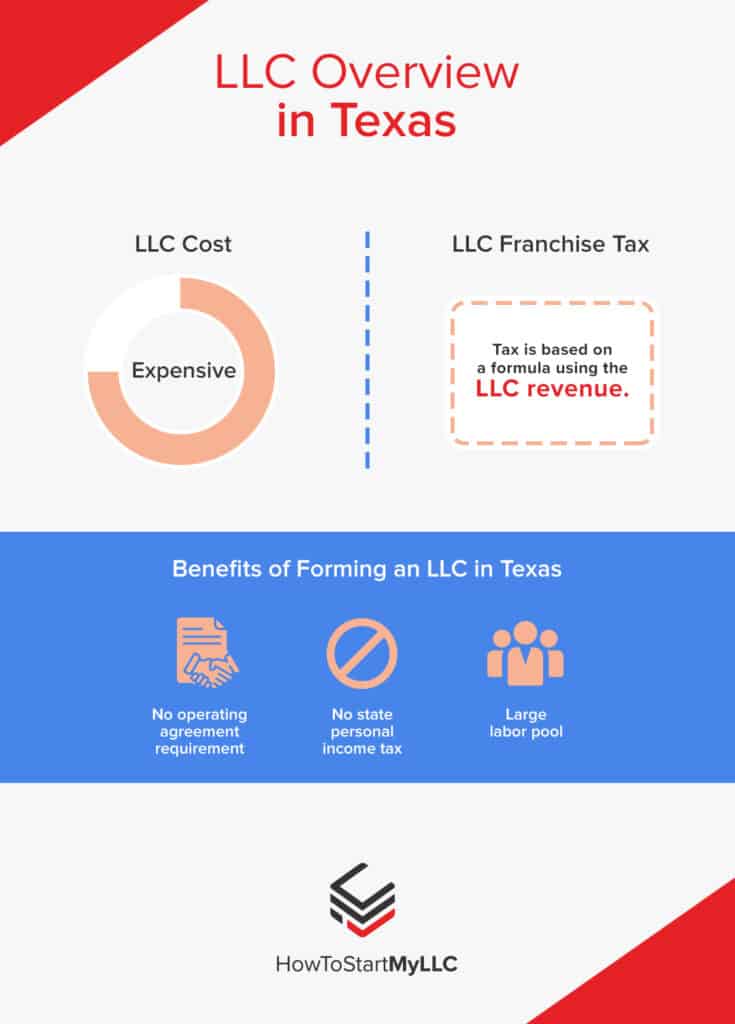
Trap one is paying a formation site hundreds of dollars for a $300 state filing plus free steps. Let us do the math so you can see it.
State filing: $300 EIN at IRS.gov: $0 Name search: $0 Total if you do it yourself: $300 + $0 + $0 = $300
If a site charges you $800 for that same set, then $800 − $300 = $500 is their added fee and add-ons. Some add-ons may help you. Some you may not need at all. Ask for a line-by-line list before you pay.
Trap two is using your home address as the agent address without a thought about privacy. Once it is on the state record, any person can look it up. If clients show up at your door without a call first, that is a real cost, even if no cash left your bank. Think about privacy before you type the address, not after.
Trap three is forming the LLC and then running all the money through your own account anyway. You paid $300 to draw a line, then you erased the line with your own habits. Forming is a one-day act. Running it apart, each day, is what makes the line count.
Trap four is thinking Texas has no yearly job at all. Texas has no Secretary of State report, and that true fact fools owners into doing nothing each spring. Then May 15 goes by, the PIR is not filed, and the state can move to take your right to do business in Texas. A date on your phone can save you that whole mess. Set the April and May alerts the same day you form.
Trap five is paying for an EIN or for a BOI report you do not need. Both traps use fear and rush. Real state and federal sites do not rush you with threats in big red text on day one. Slow down, check the web address, and check the rule date before you pay any fee that was not in the math in this post.
A good rule for all five traps is this: if a fee was not in this post's math, stop and check it on the real state or federal site before you pay it. The Secretary of State site for filing facts. The Comptroller site for tax facts. IRS.gov for the EIN. That pause can save you hundreds of dollars in your first month alone.
Your free tool for this step
Your free tool for this step is the GMB Profile Grader on aidcos.world free tools.
GMB is short for Google Business Profile. Your Google Business Profile is the free listing that shows your shop on Google Search and on Google Maps, with your name, hours, phone, and reviews. The Grader is a checklist tool. You go through the checklist for your profile, and it gives your profile a letter grade from A to F, like a school grade. An A means your profile is strong. An F means big parts are missing or wrong.
More than the grade, the tool ranks the 3 fixes that will help you most, in order. You do not get a long, foggy list of 30 tasks. You get the top 3, so you know where to start first.
Here is the honest frame for this tool. This tool does not form your LLC. The 7 steps in this post form your LLC, with the Secretary of State, the IRS, and the Comptroller. The Grader comes right after you form. Once your Texas LLC is real, grade your profile in the LLC name, fix the top 3 items, and make it easy for a new client in Texas to find you and call you. A client cannot hire a shop they cannot find.
Use it like this. Form your LLC. Open the Grader. Grade the profile in the LLC name — the same name you filed on Form 205, spelled the same way. Fix fix one. Then fix fix two. Then fix fix three. Then grade again to see your new grade. Small, clear steps, in order, beat a big rush that leaves half the work undone.
The bottom line
Start your Texas LLC in 7 clear steps and keep it strong with clean habits. Name it right, pick an agent who said yes to the job, file the Certificate of Formation, Form 205, with the Texas Secretary of State for $300 paid once, write your operating agreement, get your free EIN at IRS.gov, keep all business money in the LLC account only, and each year file your Public Information Report with the Texas Comptroller by May 15 — with no franchise tax due if your revenue is at or below $2,650,000 for the 2026 and 2027 report years, a figure you check fresh on the Comptroller site each spring. Texas has no yearly Secretary of State report and no BOI filing for a U.S. LLC under the March 21, 2025 change. Do it yourself or pay for help with your eyes open — just know the real math before you pay.
Part of: Google Business Profile Help: Costs, Fixes, and Guides for Local Businesses
More guides in this branch:
Keep reading: all Aid & Cos deep-dives